Extreme weather patterns push builders toward stronger window designs
Lifestyle

Audio By Carbonatix
1:30 PM on Friday, May 8
By Chris Garner for Reece Windows & Doors, Stacker

Extreme weather patterns push builders toward stronger window designs
According to Climate Central, since 1980, the U.S. has experienced 431 weather events with damages exceeding a billion dollars. 2025 saw 23 of these weather events. It’s important to always be prepared and have a plan in place. While people can evacuate to a safe place, their home and everything they own stay behind and face the environmental impact. Physical safety is important, but a home is a different type of safety: financial and emotional.
Relying on historical weather averages has become an increasingly high-risk strategy for property owners. Data aggregated by NOAA illustrates a concerning shift; in 2024 alone, high-intensity weather events resulted in an estimated $182.7 billion in domestic damages. In response to this volatility, building science has pivoted toward proactive structural fortification, with engineers and manufacturers focusing on high-performance materials that maintain structural integrity under extreme stress.
Below, Reece Windows & Doors explains how evolving weather patterns are influencing modern window design and home resilience.
Low-Emissivity (Low-E) Coatings
While Gulf Coast states like Texas, Florida, and Louisiana have long managed predictable high-heat indices, this thermal volatility has expanded into traditionally temperate regions, including the Pacific Northwest and the California coast.
To maintain interior climate stability, standard residential cooling strategies often involve running HVAC systems at maximum capacity for extended durations—a practice that leads to premature mechanical failure and inflated utility expenditures. A more sustainable mitigation strategy involves the integration of Low-Emissivity (Low-E) coatings. These microscopic, transparent layers are engineered to regulate thermal radiation by controlling how heat energy interacts with the glass surface.
During periods of high solar intensity, these coatings reflect a significant portion of infrared heat away from the building’s interior. Conversely, during colder cycles, the same technology helps retain indoor ambient warmth by reflecting internal thermal energy back into the living space, effectively stabilizing the home's "thermal envelope."
When installed correctly, these windows can significantly improve indoor comfort while reducing energy consumption. They also block a large percentage of UV rays, helping protect furniture, flooring, and finishes from fading over time.
Impact-Resistant Laminated Glass
Hurricanes, high-wind events, and hail bring flying debris and increased pressure, putting windows at risk. In areas where these weather patterns are common, homes are equipped with storm shutters and panels, and more recently, impact-resistant glass has also become part of modern protection strategies.
Impact-resistant windows use laminated glass, which consists of two panes of glass bonded together by a clear, flexible interlayer, typically polyvinyl butyral (PVB) or ionoplast polymer. Due to this design, when struck by flying debris, the outer glass may shatter, but the fragments remain adhered to the interlayer.
These windows are tested against high velocity impacts (such as a 9-pound 2x4 timber shot at 50 feet per second) to ensure the barrier remains intact during sustained storm cycles.
Noble Gas Infills and Multipane Insulation
In areas with thermal extremes, condensation and moisture are the biggest enemies to windows. This is why manufacturers use noble gases like argon or krypton instead of ambient air to fill the space between double or triple-paned windows.
These gases are denser than air and have lower thermal conductivity. By keeping the internal glass pane closer to the room's temperature, these gases prevent condensation and frost buildup during extreme cold snaps, which protects the window frame from moisture-related rot or mold.
Advanced Frame Materials
Extreme weather patterns often involve rapid temperature swings that cause materials to expand and contract, leading to cracked windows, loose frames, or expensive repairs. To avoid such inconveniences, modern frames use fiberglass or composite materials rather than traditional aluminum or unreinforced vinyl.
Fiberglass has a very low expansion coefficient, similar to the glass it holds. This means the frame and the glass move together, maintaining the integrity of the weather seals even during 40-degree temperature shifts.
Modern Window Designs Shaped By Extreme Weather Patterns
Extreme weather is already shaping how homes are built, upgraded, and maintained. And while no window can make a home completely immune to the elements, the right design choices can significantly reduce risk, improve comfort, and lower long-term costs.
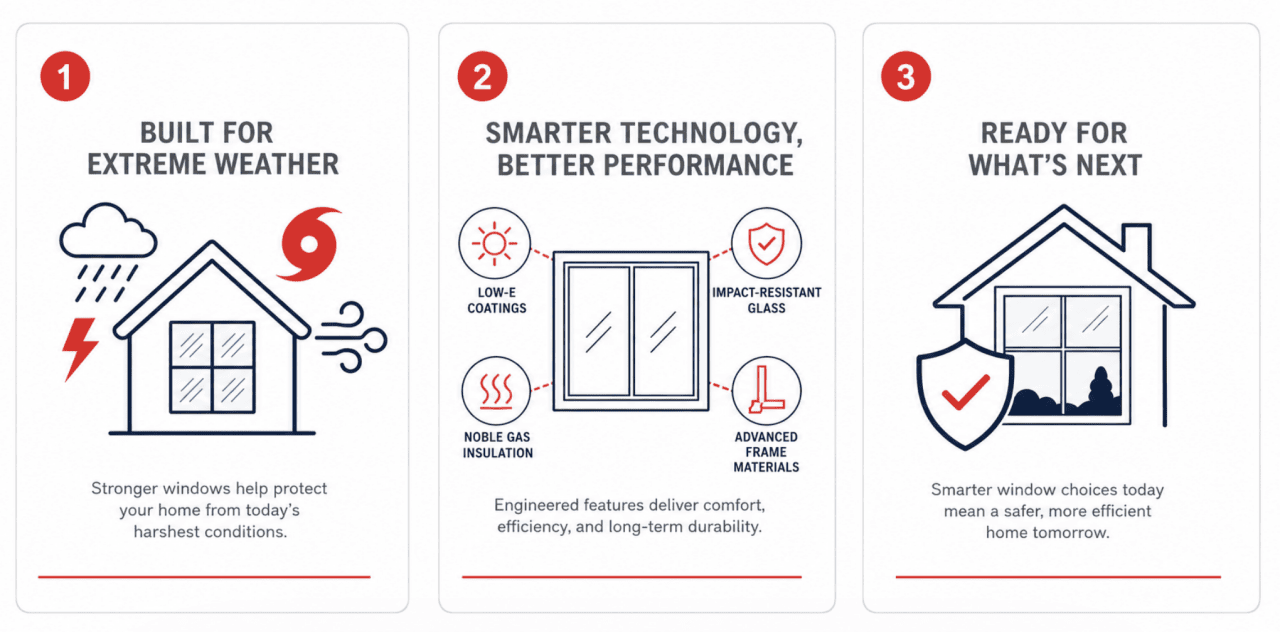
Today’s window technology is designed around resilience and efficiency. From Low-E coatings that manage heat to laminated glass that withstands impact to advanced insulation and frame materials, each innovation solves a specific problem homeowners are increasingly facing.
As weather patterns continue to evolve, homes that adapt with them will always be one step ahead.
This story was produced by Reece Windows & Doors and reviewed and distributed by Stacker.